The future of middle management in ai era
AI is eliminating half of all middle management roles by 2026.
That's not a prediction. That's a Gartner projection — and the displacement is already underway in organisations across every sector.
The managers being eliminated are not the worst performers. They're the ones whose primary value was coordination: assigning tasks, checking status, compiling reports, passing information from executive meetings to front-line teams.
AI does all of that faster, cheaper, and without the politics.
But here's what's equally true — and what almost nobody is talking about clearly enough:
The managers surviving this wave aren't the ones who managed best. They're the ones who always did something AI fundamentally cannot do.
The surviving managers are being called 'Insight Architects.' Their job is to look at what AI produces and ask: 'So what?' Not what the data says — what it means. Not what the report shows — what to do next.
What AI Actually Cannot Do
The artificial intelligence leadership conversation in 2026 is dominated by fear on one side and hype on the other. Both miss the more interesting question: what does AI genuinely struggle with, and what does that mean for the humans it works alongside?
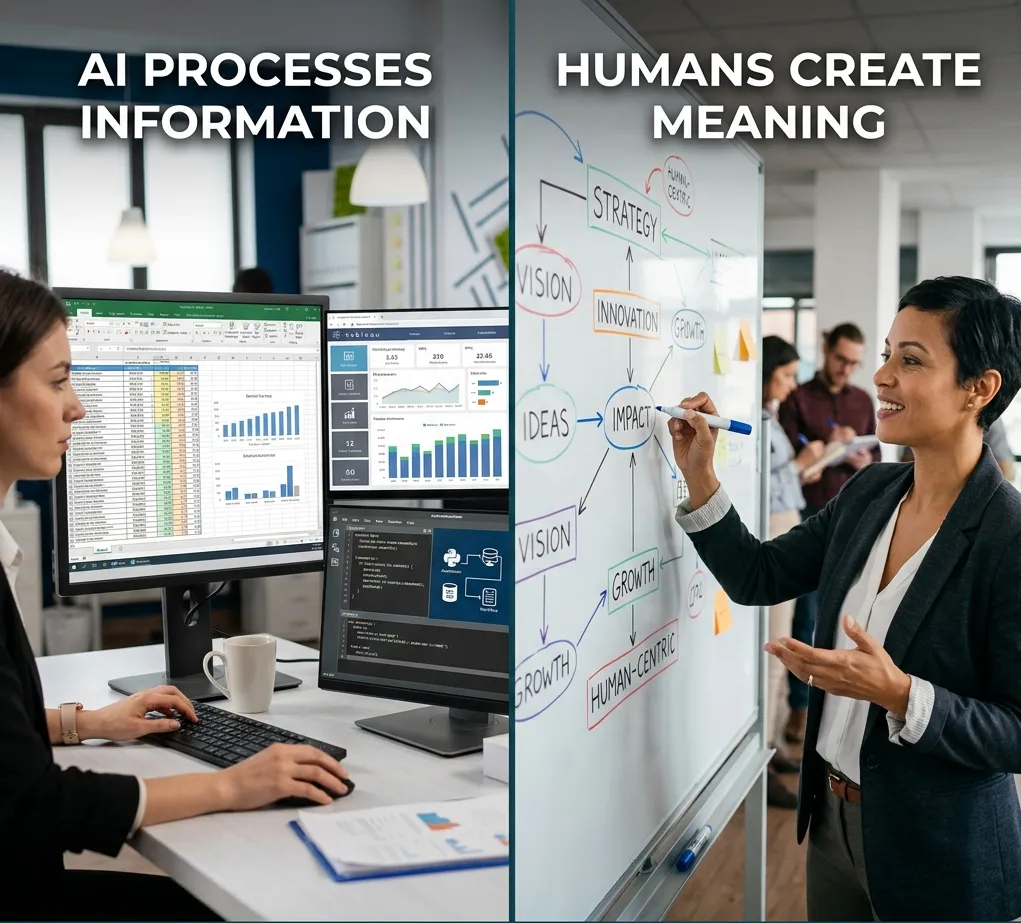
AI processes information brilliantly. It synthesises, pattern-matches, summarises, and generates at a speed no human team can match. These are real capabilities and the organisations that ignore them are making an expensive strategic mistake.
But AI cannot provide context. It cannot connect dots across silos fragmented by human politics and organisational history. It cannot make the judgment call with accountability attached to it. It cannot look at a number and ask the question that changes everything: given everything I know about this organisation, this market, and these people — so what does this actually mean?
That question — the 'so what?' question — is the one that survives automation. And it's the question that the best leaders have always been asking, even when they were buried under the coordination work AI has now absorbed.
The Insight Architect: What Surviving Management Looks Like
The managers who are thriving in the AI era share a set of characteristics that have nothing to do with technical proficiency and everything to do with distinctly human capabilities.
They Ask Better Questions
Not 'what does the data say?' but 'what is the data not telling us?' Not 'what happened?' but 'why does it matter — and for whom?' The quality of the question determines the quality of the insight. AI can generate answers at scale. It cannot generate the right questions.
They Provide Context AI Lacks
Data is always historical. Context is present and future. The Insight Architect brings to AI-generated analysis everything the model couldn't know: the relationship that's under strain, the cultural dynamic that will shape how this recommendation lands, the history that makes this number mean something different than it appears.
They Make Judgment Calls With Their Name Attached
AI can recommend. It cannot decide — not in the sense that matters. The decision that carries consequence, that someone will be held accountable for, that will define a team or organisation's direction — that still requires a human being willing to own the outcome.
The leaders who thrive in the AI era aren't the ones who manage AI most efficiently. They're the ones whose human judgment becomes more valuable as AI handles everything else.
What This Means for Leaders Right Now
If your primary value as a leader is coordination — managing information flow, tracking task completion, compiling status updates — the AI era requires an honest reckoning.
Not because you're replaceable as a person. But because the specific activities that consumed most of your time are being absorbed by systems that do them faster and without the overhead.
The leaders who are positioning well right now are doing two things simultaneously.
First, they're aggressively offloading everything AI can handle to AI. Not gradually, not cautiously — completely. The goal is to clear as much of the coordination workload as possible, as quickly as possible, so that human attention can go where it actually matters.
Second, they're investing heavily in the capabilities that AI cannot replicate: judgment, context, relationship, ethical discernment, and the ability to ask the question that changes what the data means.
The question isn't whether AI is coming for your role. It's whether your role was ever really about the things AI is taking — or whether it was always about something deeper that the coordination work was obscuring.
KEY TAKEAWAY: AI is eliminating the coordination layer of management — but creating enormous demand for the judgment, context, and insight that no model can provide. The leaders who survive and thrive in 2026 will be the ones who clear their runway of everything AI can handle and go all-in on everything it can't.
Joe Cook
Pursue. Engineer. Capture.
