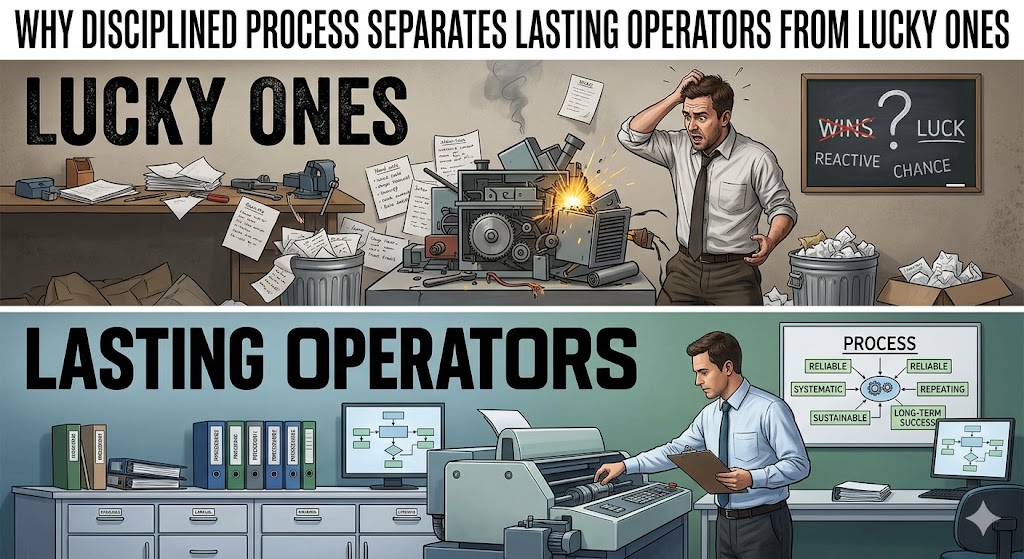
Why Disciplined Process Separates Lasting Operators from Lucky Ones
In every market cycle, there are two types of winners:
the ones who got lucky… and the ones who got repeatable.
At first glance, they can look the same. Both close deals. Both post returns. Both build momentum. But over time, the gap becomes obvious.
One fades when conditions change.
The other compounds.
The difference isn’t intelligence. It isn’t timing.
It’s process.
Luck Can Start a Run. Process Sustains It.
Markets hand out wins all the time—good timing, favorable conditions, a deal that works despite weak assumptions. Early success often has more to do with environment than skill.
The problem? Luck doesn’t scale.
Without a disciplined process, success becomes inconsistent:
One great deal followed by two mediocre ones
Strong quarters followed by unexplained drawdowns
Decisions driven by momentum instead of logic
Process is what turns isolated wins into a system.
What a Disciplined Operator Actually Does Differently
Disciplined operators don’t rely on outcomes to validate decisions. They rely on standards.
They define:
What a good deal looks like before they see it
What risks are acceptable before they’re tempted
What assumptions must hold before capital is deployed
They don’t adjust criteria to fit opportunities.
They filter opportunities through criteria.
That sounds simple. It’s not.
Because discipline shows up most when:
The deal is close
The pressure is high
Everyone else is moving faster
Saying “No” Is the Real Edge
Most people think great operators win by finding better deals.
In reality, they win by avoiding bad ones.
A disciplined process creates friction:
Deals get rejected
Timelines get extended
Opportunities get passed on
In strong markets, that can feel like falling behind.
But in difficult markets, that restraint becomes survival—and eventually, advantage.
Consistency Beats Intensity
Anyone can be disciplined when things are easy.
The real test is consistency:
Sticking to underwriting standards when competition loosens theirs
Maintaining communication with investors when results are uncertain
Continuing to execute when outcomes aren’t immediate
This is where process separates from personality.
Motivation fades.
Markets shift.
Pressure builds.
Process stays.
The Illusion of the “Hot Streak”
Short-term success often gets mistaken for skill.
But without a process behind it, a hot streak is just that—a streak.
Lasting operators don’t chase streaks. They build systems that:
Produce predictable decision-making
Reduce emotional variance
Improve over time through feedback
They’re not trying to be right every time.
They’re trying to be consistently rational over time.
When the Cycle Turns, the Truth Shows Up
Easy markets hide weak processes.
Hard markets expose them.
When conditions tighten:
Margins shrink
Mistakes matter more
Assumptions get tested
This is where luck runs out.
And this is where disciplined operators stand out—not because they avoid all losses, but because their process:
Limits downside
Preserves capital
Keeps them in the game
Process Is a Long-Term Advantage
The real power of discipline isn’t just protection—it’s compounding.
Over time, a strong process:
Improves decision quality
Builds trust with partners and investors
Creates a track record that isn’t dependent on conditions
It becomes an asset in itself.
Final Thought
Anyone can look like a great operator in the right environment.
But only a few can perform across cycles.
Those are the ones who:
Define their standards early
Stick to them when it’s inconvenient
And refine them continuously
Because in the end, success isn’t about catching the right moment.
It’s about building a process that works in any moment.
