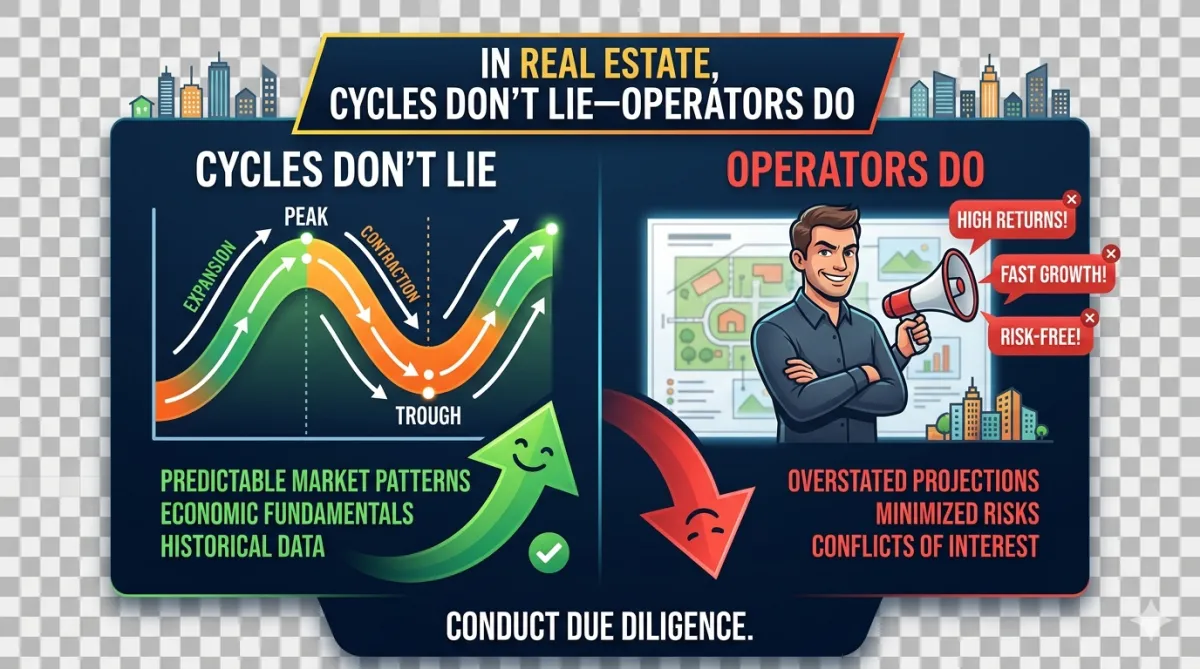
In Real Estate, Cycles Don’t Lie—Operators Do.
I used to think the most successful operators in commercial real estate were the ones who raised the
most capital.
45 years later, I know different.
The best fundraisers and the best investors are two completely different people. In a bull market,
nobody checks — because the returns hide the gap. The cycle always reveals the truth.
The bull market illusion
When capital is cheap and rents are rising, almost everyone looks like a genius. The best fundraiser
raises the most capital. The most aggressive underwriter shows the best projected returns. The
flashiest brand attracts the most attention.
And for a while — it works.
Then the cycle turns. Rates move. Sentiment shifts. Bridge loans come due with no refinancing path.
Floating rate debt doubles debt service. Optimistic rent growth assumptions meet flat or declining
markets.
The operators who built on hype start making emergency capital calls. The operators who built on
discipline? They're still standing.
Three things that separate survivors from casualties
After navigating every major market cycle since the 1970s, the difference comes down to three
things:
1. Debt structure over return optimization. The most dangerous sentence in real estate: 'We'll
refinance before it comes due.' Disciplined operators lock in long-term fixed rate debt — even when it
means lower projected returns. A 12% return with 20-year fixed debt beats an 18% return with a
3-year bridge loan every single time a cycle turns.
2. Reserve depth over capital efficiency. Aggressive operators deploy every dollar. Disciplined
operators keep dry powder. Deep reserves aren't inefficiency. They're the cost of staying in the game
when surprises arrive — and they always do.
3. Underwriting reality over fundraising narrative. The best deals I've passed on were the ones
where the numbers only worked in the best-case scenario. Disciplined underwriting assumes flat rent
growth, conservative exit cap rates, higher vacancy than the market shows. It makes the pitch deck
less exciting. It also makes the investment survivable.
The question every investor should ask
Before placing capital with any operator, ask one question:
'Show me a deal you passed on — and why.'
The answer tells you everything. Great operators have a library of deals they didn't do. That discipline
— applied consistently, across every market environment — is what protects capital over decades.
Not the pitch deck. Not the projected IRR. Not the brand. The discipline.
If you're an accredited investor evaluating private market opportunities, I'd welcome a conversation about how
we think about structure, risk, and long-term capital preservation.
